


Timeline
Q1–Q2 2025 · From design to Web & Mobile development
My Role
Product Designer · Hands-on design
Working With
PM / Web & Mobile Developers / Customer Success
KRW 1B+ Enterprise Deal
Revenue Contribution
Starting Point
The product was a collaboration tool built around five task statuses: Requested, In Progress, Feedback, Completed, and On Hold. This simple structure made workflows easy for users to understand, but it lacked the flexibility to support the different processes used across industries.
The customers had consistently requested more granular task statuses and workflows that could be configured for their organizations.
A Constraint on Business Expansion
Task status was one of the product’s core features, but it had remained largely unchanged for nearly four years following the first major redesign.
Over time, customer needs became increasingly diverse, yet the existing system could not accommodate many of them. This became an ongoing constraint as the company sought to expand the product into new industries and larger organizations.
Different Priorities Across Leadership and Product Teams
At the time, leadership and the product team had different views on what should be improved first, which sometimes created tension during prioritization.
The company often prioritized features that could address immediate business opportunities, even when they were not directly tied to the product’s core value. The product team, on the other hand, saw improving the core experience as increasingly urgent, based on the growing volume of customer feedback.

Fixed Task Statuses

Previous Task UI
Key Decisions
How did we move the problem forward?
1. Team leads consistently raised the issue
Team leads, including myself, continued to bring customer pain points and the need for improvement into regular meetings and separate discussions. We emphasized the importance of listening more closely to customers.
At times, this led to strong disagreements with leadership. As discussions continued without clear resolution, many team leads experienced growing fatigue and frustration.
2. The research team collected and shared customer feedback
Each quarter, the research team collected customer feedback, prioritized improvement requests, and shared the findings on a company-wide board.
This helped the organization see which problems customers encountered most frequently and provided a stronger basis for discussing improvements around actual user needs.
3. The development team pushed for a reassessment of priorities
Whenever projects appeared misaligned with the product’s core value, the development team actively raised concerns.
With constant pressure on development schedules, they were particularly sensitive to prioritization and became one of the strongest advocates for refocusing resources on improvements to the core product.

Custom Status Setup

Updated Task UI
What Was Difficult or Beyond My Direct Control?
1. Implementation constraints caused by the legacy architecture
Changing only the settings interface would not solve the underlying problem. We also had to consider the impact on existing features and the overall scope of development.
Even when an idea clearly addressed a user need, the legacy environment made it difficult to implement everything as envisioned. This required continuous alignment between the proposed experience and what could realistically be delivered.
2. Building support for core product improvements amid competing business priorities
As the company explored multiple growth opportunities and business directions, reaching alignment on product priorities was challenging.
We needed to demonstrate to leadership—who were also considering opportunities beyond the core product—why improving an existing core feature should take priority and how doing so could directly support business growth.
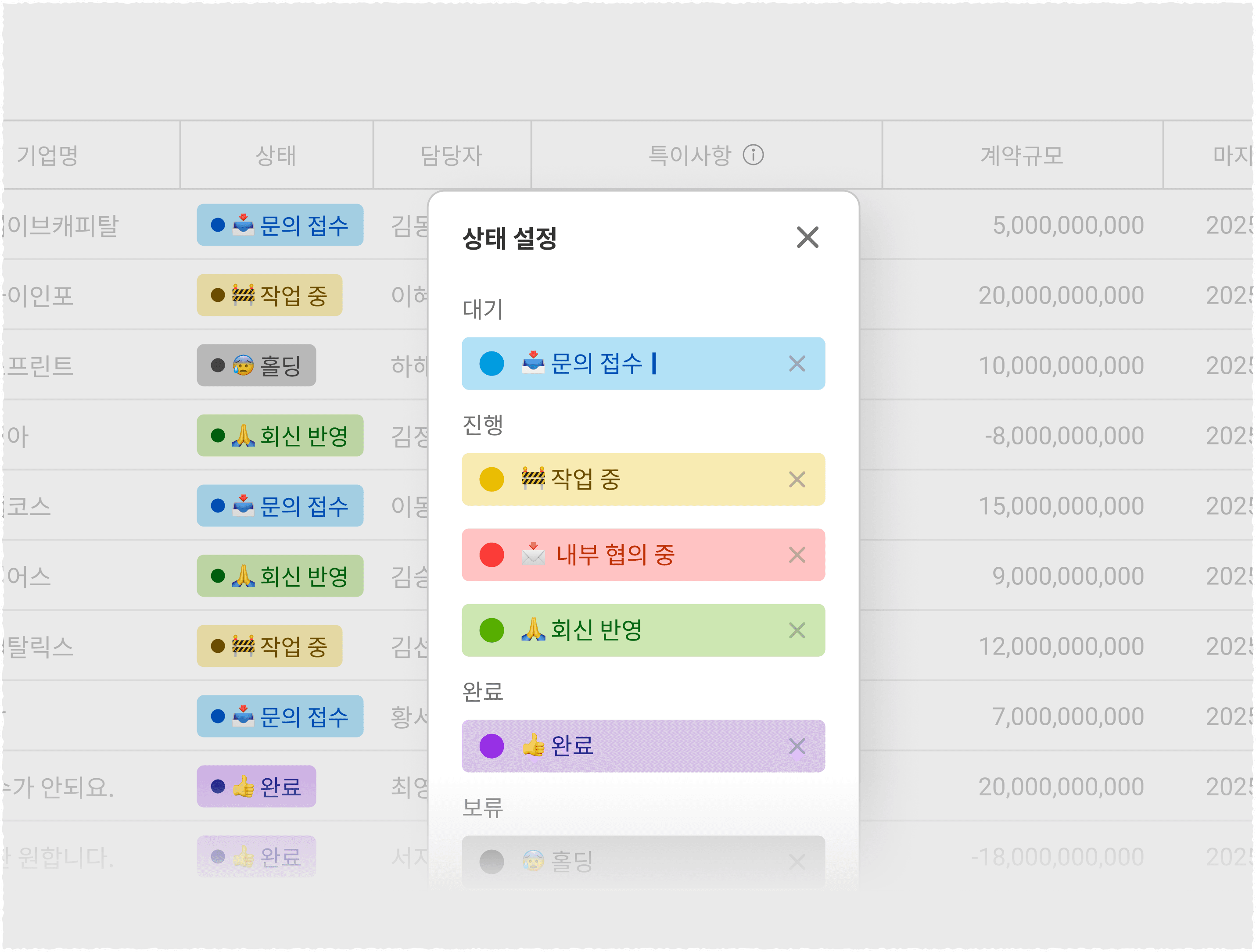
Multiple Task Status Settings

Task Category Expansion
The Team Behind the Product
PM & Design Team
We translated customer requests into product requirements and coordinated scope and priorities with the design and development teams.
Together, we discussed how far the product should go in supporting different organizational workflows and clarified the requirements and policies needed for the design.
Web & Mobile Development Teams
The development teams assessed the constraints of the existing architecture and explored feasible implementation approaches.
We aligned the experience of configuring and viewing task statuses across Web and Mobile, continuously resolving gaps between the intended design and technical implementation.
Customer Success Team
The Customer Success team shared recurring customer pain points and requests related to the existing task status system.
They also provided examples of workflows that required more granular statuses and highlighted differences between organizations, helping us better understand the context in which customers used the product.
Outcome
The enhanced workflow functionality helped secure an enterprise project with a major global automotive manufacturer that the product had previously been unable to support, directly contributing to revenue growth.
Addressed functional limitations experienced by existing customers
Established a foundation for expansion into manufacturing and large-enterprise markets
KRW 1B+ Enterprise Deal
Revenue Contribution
Reflection
Core features can unlock new business opportunities
Customer needs matter more when tied to business impact
Repeated customer requests alone were not enough to raise the priority of the improvement.
We needed to connect unsupported customer workflows with the business opportunities we were missing as a result. I learned that combining customer evidence with business goals makes a much stronger case for product investment.
Product strengths should evolve as the product grows
The five-status structure had been a strength because it was simple and easy to understand. As our customer base expanded across industries and organization sizes, however, that same simplicity began to create limitations.
This project taught me that even proven product decisions need to be revisited as the business grows.